 Step by Step Guide
 How to change a flat tire safely, without calling for help
The full walkthrough for swapping a flat tire on your own: where to pull over, how to place the jack, the right order to loosen the lug nuts, and what to do after.
Updated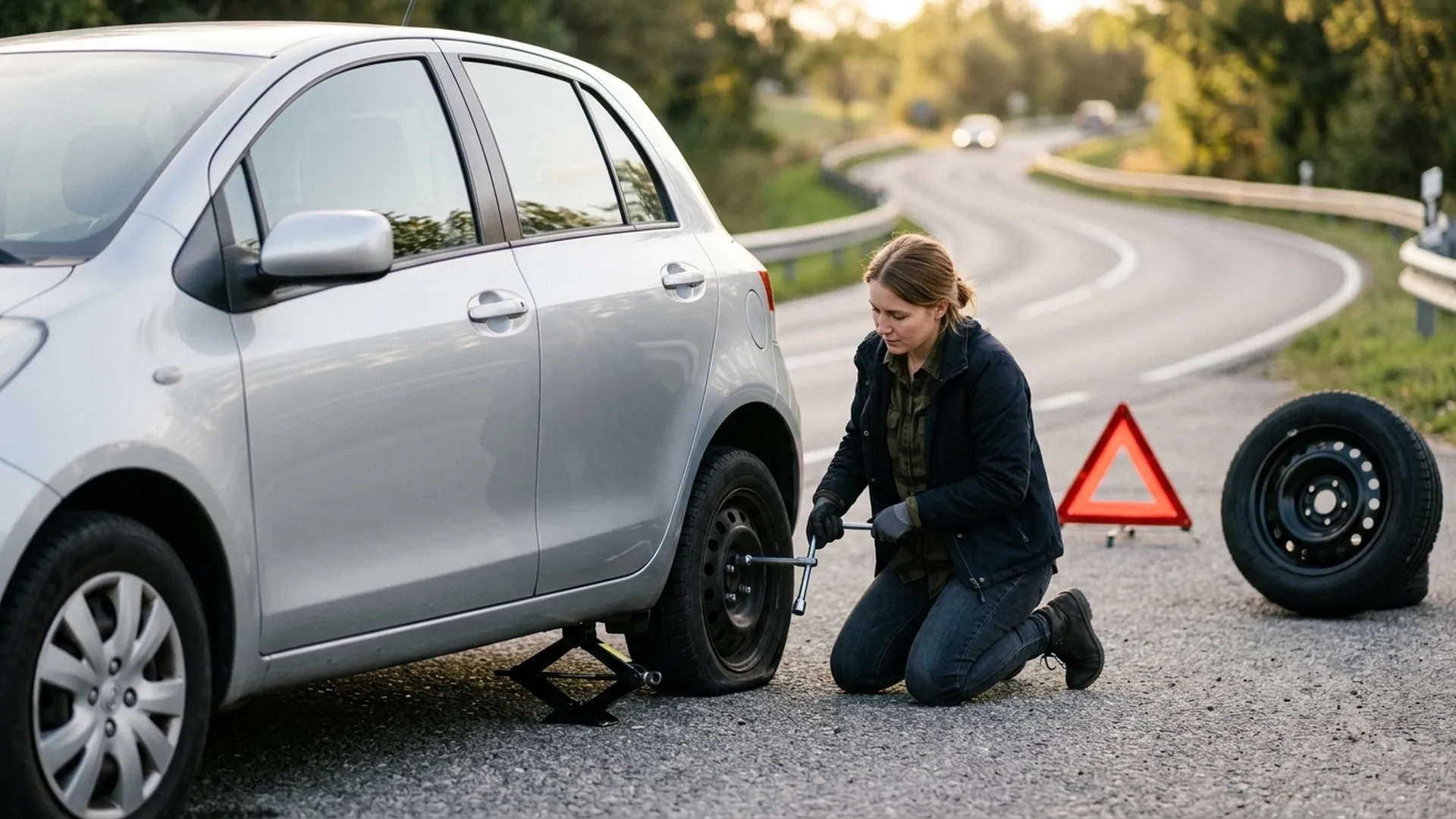
Flat tires almost never happen at a convenient time: it’s dark, it’s raining, or you’re already late. The good news is that changing a tire is one of the simplest bits of car maintenance there is, and the part that actually matters isn’t strength — it’s picking the right spot to stop and doing the steps in the right order.
This guide covers ordinary passenger cars that came with a spare, a jack, and a lug wrench from the factory. If you drive a large SUV, a pickup, or a newer car that only has a tire inflator kit instead of a spare, the logic is the same, but check your owner’s manual because the jacking points move.
Safety first: on a busy highway with no real shoulder, do not change the tire yourself. Turn on the hazards, get out on the passenger side, walk far away from traffic behind the guardrail, and call for roadside assistance. No tire is worth being hit by a truck.
Before you start
Check at home, in daylight, that you actually have everything you need. It’s a terrible feeling to discover in the dark that the jack is missing or the spare is flat.
- A spare tire with correct pressure (check it every couple of months)
- The jack and lug wrench, usually stored under the trunk floor
- A reflective triangle or road flares
- A flashlight (your phone works, but holding a phone with greasy hands is miserable)
- A piece of cardboard or an old mat to kneel on
- Work gloves if you have them
Pull over in the right spot, not the first spot
Slow down without slamming the brakes and look for a stretch that is flat, firm, and as far from moving traffic as possible. Avoid curves, freeway on-ramps, gas station driveways, and any sloped surface — on a slope the car can slide off the jack.
Turn on the hazards before you stop. Loose gravel, soft dirt, and sand are terrible because the jack sinks in. If dirt is your only option, slide a flat board or a flat rock under the base of the jack before you start lifting.
Signal the car and lock it down
Set the parking brake all the way, put a manual transmission in first gear (or an automatic in Park), and shut the engine off. Place the reflective triangle about 100 feet behind the car, farther if you’re on a highway or just past a curve.
Get every passenger out of the car and away from the traffic side — behind the guardrail, up on the grass, anywhere but standing next to the driver’s door.
Get the spare and the tools out first
It sounds obvious, but plenty of people jack the car up and then discover the spare is pinned under all their luggage by a wing nut that won’t budge. Pull everything out with the car still sitting flat: spare, jack, wrench.
Lay the spare on the ground near the wheel you’re about to remove. It doubles as a backup — if the car ever slips off the jack, the spare under the frame will keep the body off the pavement.
Break the lug nuts loose while the car is still on the ground
This is the step almost everyone gets wrong. Fit the lug wrench onto each nut and turn it just a half-turn to break it loose, without removing anything yet. With the tire flat on the pavement the wheel can’t spin on you, and you can actually put real force into it.
Loosen in a crossing pattern — an X for four lugs, a star for five — never in a circle. If a nut is really stuck, put the wrench arm horizontal and step down on the end of it with your weight, rather than pulling up.
Place the jack on the reinforced lift point
Look under the side of the car for a reinforced pinch weld: usually there’s a notch, an arrow, or a small triangle stamped into the metal to mark it. That’s the only spot strong enough to take the load. A jack placed anywhere else will crumple the rocker panel, split a brake line, or, worst case, punch through.
Raise slowly until the flat tire is only a couple of inches off the ground. The higher you lift, the more unstable the car becomes. Never put any part of your body under a car held up by nothing but a jack.
Swap the wheel
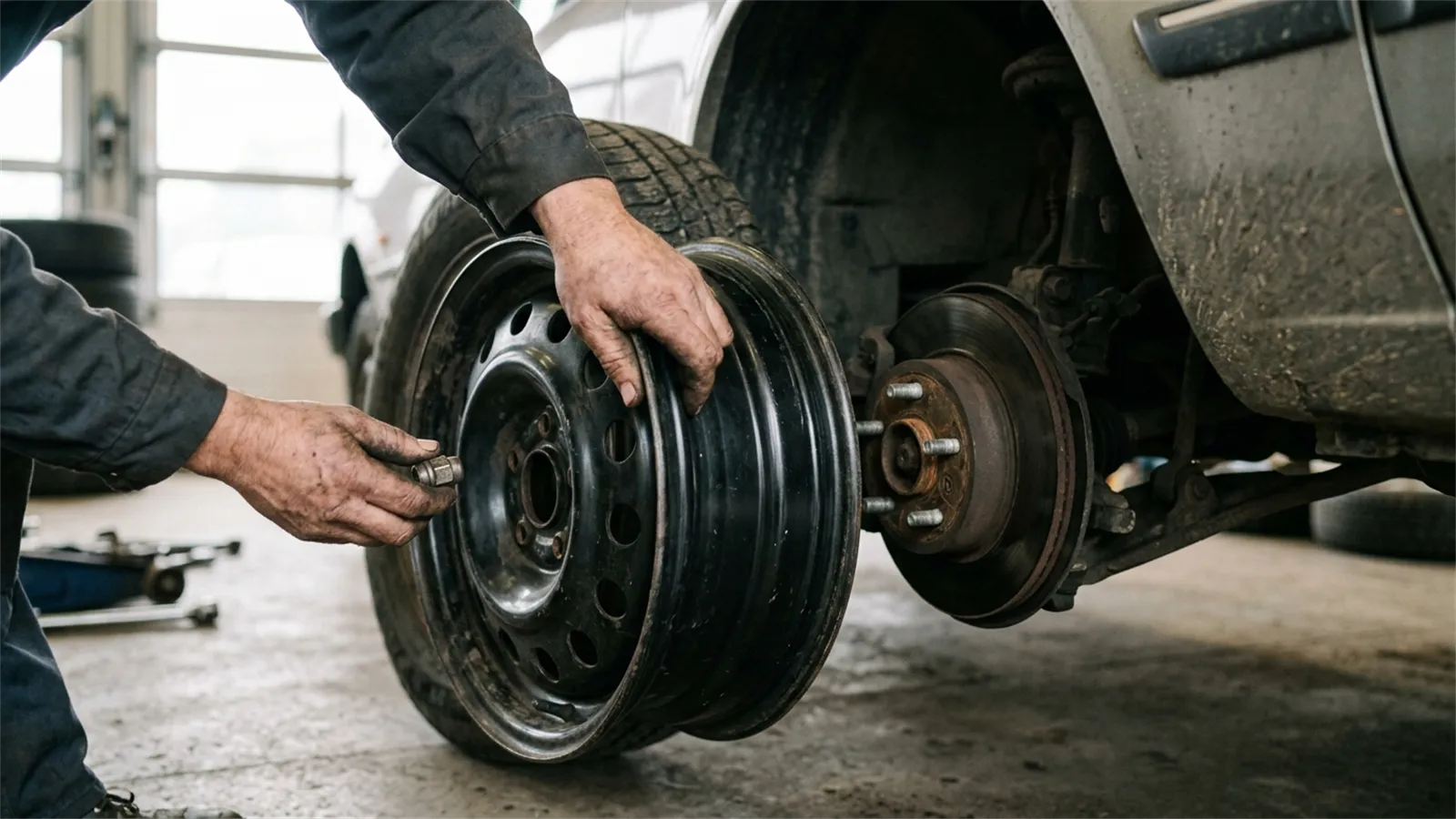
Now spin the loosened lug nuts off the rest of the way, and keep them all together in a pocket or inside the hubcap turned face-up. Pull the flat tire straight toward you, keeping your back straight and lifting with your legs — the wheel is heavier than it looks.
Line the spare up with the studs, push it all the way home, and thread the lug nuts back on by hand, snugging them in a crossing pattern. Hand-tight only, for now.
Torque on the ground and check pressure
Lower the jack until the tire touches down and starts carrying weight, then do the final tightening — again in a crossing pattern, alternating from one side to the other. Tighten firmly, but don’t bounce on the wrench like a maniac: an overtorqued lug is just as bad as a loose one, because it distorts and later won’t come off.
Stow the flat, the jack, and the wrench, pick up the triangle last, and check the spare’s pressure at the first gas station. If you’re on a compact spare, respect the speed limit printed on it.
Common mistakes that cost money
- Jacking the car up before loosening the lugs. The wheel just spins in the air and you have no leverage.
- Tightening in a circle. The wheel seats crooked, the steering wheel shakes, and the hub wears unevenly.
- Wrong jacking point. A dented rocker panel is expensive body work and it destroys the strength of that lift point forever.
- Forgetting to actually fix the flat. Now you’re driving around with no spare, and the next flat will happen on a long trip.
- Leaving the hubcap on the shoulder. Toss it in the trunk the moment it comes off. It’s the single most abandoned item in America.
After the change
Get the flat to a tire shop soon, because a same-day patch is cheap and doable, while a tire that rolled deflated for miles is usually scrap. While you’re there, ask them to check the torque on the spare’s lug nuts and to look at the alignment if you felt any vibration on the drive over.
If you noticed a tool you wished you had, put together a small kit for the trunk right now: gloves, a decent flashlight, a piece of cardboard, a flat wood block for the jack base, and a four-way cross wrench, which gives far more leverage than the flimsy L-shaped wrench that came with the car.
Frequently asked questions
Can I drive on a flat just to reach a shop?
Only if the shop is within a block or two and you crawl there. Driving on a deflated tire destroys the wheel and can damage the suspension, and a new alloy wheel costs far more than a new tire. If it is farther than that, change it or call for a tow.
How long can I run on a compact spare?
The skinny "donut" spare is meant to get you to a tire shop, not for daily driving. Respect the speed limit printed on the sidewall, usually 50 mph, and swap back to a full-size tire as soon as you can.
What if the lug nuts are stuck?
With the car still on the ground, put the wrench on the nut and step on the wrench arm using your body weight, never yank up on it. If it still refuses to move, the previous shop likely overtightened it with an impact gun, and the safe move is to call roadside help instead of snapping the wrench.
Do I need to check the spare's pressure afterward?
Yes. A spare that sits for months loses pressure, so top it off at the first gas station and add it to your routine pressure check every couple of months along with the other four tires.
Informational content. For risky situations or technical, legal or medical doubts, talk to a professional.