 Step by Step Guide
 How to organize your wardrobe (and keep it that way)
A step-by-step method to empty your closet, sort what to keep, donate or sell, and store clothes by type and season, with boxes and a weekly routine that keeps everything in order.
Updated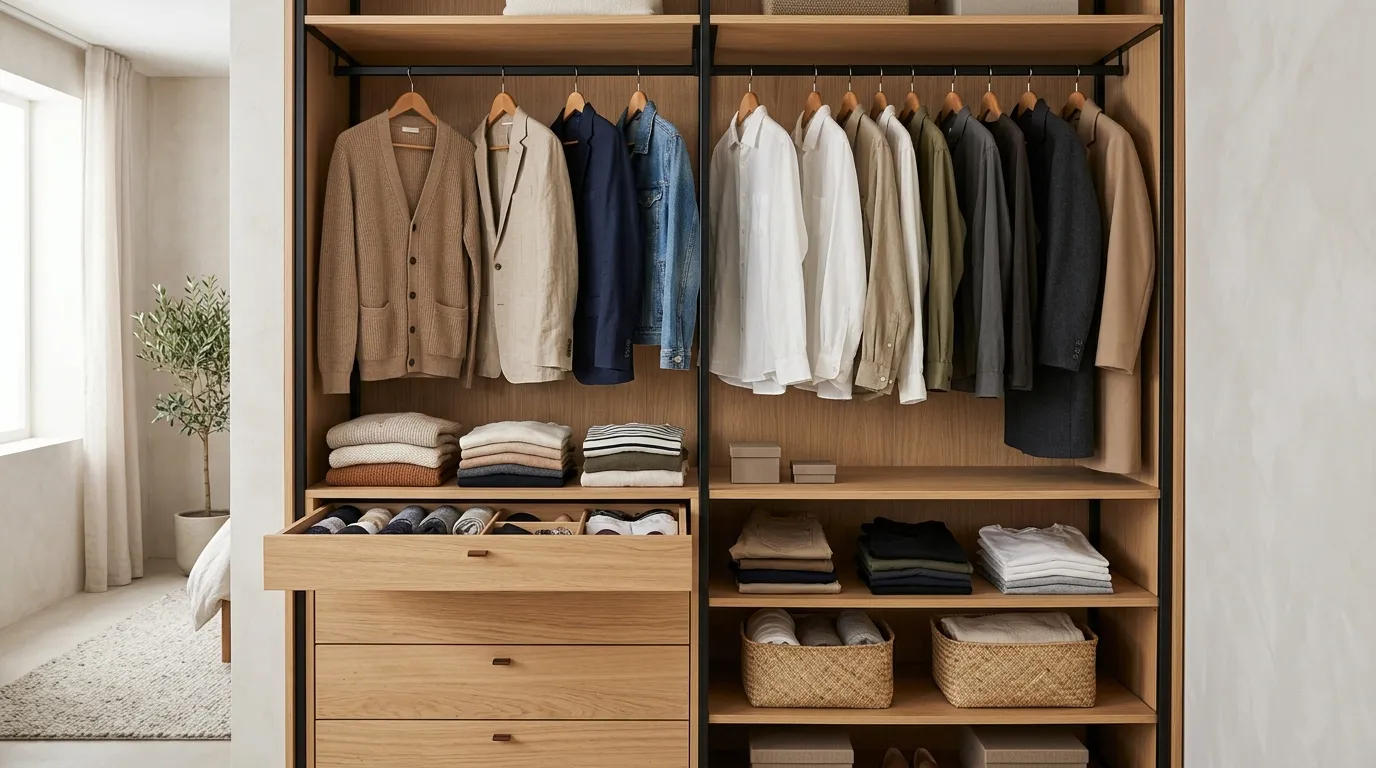
An organized wardrobe is not the one that looks like a store display after an afternoon of tidying — it is the one where the order survives the week. Most people organize everything, and within a few days it is all back in that tangled pile of clothes that will not let the door close.
This guide is a first-time organizing method (the one you do once) plus a maintenance routine (the one that keeps it from getting messy again). The first part takes longer and is all about deciding: taking everything out, sorting, and choosing what stays. The second part is nearly effortless, but it is what changes the long-term result.
Golden rule: before anything goes back in the wardrobe, it has to have a home. If a piece has no defined place, you will toss it into the first open spot — and that is how the mess comes back.
Before you start
Pick a weekend or a clear morning, preferably when you are not in a hurry. If you are sharing the closet, agree on it beforehand, because the “what stays” decision is the one that stalls — and a conversation shortens it a lot.
- Empty boxes or large bags for the three piles
- Bags or boxes for donation (set them apart from what you will sell)
- Thin, sturdy hangers, ideally all matching
- Drawer dividers or organizers
- Labels or masking tape to mark the boxes
Take absolutely everything out
This step is non-negotiable. Take out everything — shelves, drawers, the rod, coat pockets, boxes from the back. People who organize in sections, choosing what to store on each shelf, tend to protect the mess that was already there and miss the bigger win they could get from a bolder decision.
Put it all on the bed or the floor, with at least three marked spots beside it (bed, rug or chairs work): one for keeping, one for donating and one for selling. Seeing everything at once is the reality check that makes the process work.
Sort into three piles: keep, donate, sell
Pick up each piece and decide without overthinking. The keep pile is only for what you actually use; the donate pile for what is in good shape but you do not wear; and the sell pile for what has resale value (known brands, clothes with tags, pieces in great condition).
Use the 12-month rule: if you have not worn it in the past year and it is not a seasonal piece that has not come back around yet, it goes to donate or sell, not keep. A piece of clothing that only takes up space is a tax you pay every day without noticing. If the item is torn, stained beyond repair, full of holes or has lost its color, it goes straight to the discard pile (or donation only if it is still usable).
Do not try to make everything perfect: the goal is to decide quickly and move on. The three piles are what make the decision fast.
Make the most of the space and clean it first
With the wardrobe empty, this is the moment for the changes nobody ever gets to: wipe down the inside of the piece (dust and lint settle at the back), check that the rod holds the weight, and replace bent or broken hangers. When a hanger snaps under a heavy piece, you find out only when the item is already on the floor, creased.
Also think about placement — the part most people ignore. The most comfortable rod, at eye and hand level, is what should hold what you use every week. Top shelves near the ceiling are the right home for off-season items.
Fold and hang the right way
How you store a piece decides whether it wrinkles and whether the stack collapses. Hanging is better for: shirts (to avoid creases), coats, blazers, dresses, delicate tops. Folding is better for: everyday T-shirts, sweatshirts, sleepwear, anything that does not need to hang.
In drawers, fold pieces standing up — folded in half or into rolls — instead of stacking them flat. The flat pile comes apart every time you reach for the bottom piece; a standing piece stays put and you can see everything at once, like files in a box. For shirts, the trick is to fold front side down and then bring the sleeves into the center, keeping the front crease-free.
Organize by type and season
Divide the wardrobe into broad groups, always in the same order: tops and T-shirts, then shirts and blouses, pants, skirts/dresses, coats and blazers, and finally sleepwear and underwear (in separate drawers). Inside each group, sort by color so it is easier to pick out an outfit.
Inside each group, separate by season: the everyday items of the current season go front and center at eye level, and off-season items go up to the top shelves. This cuts a big chunk of the “I have nothing to wear” feeling — because what you see is only what fits the weather right now.
Use boxes for the occasional stuff
Boxes are the right home for off-season clothes, scarves, belts, extra socks and travel keepsakes. Choose closed, labeled boxes — one per category (“summer”, “winter”, “accessories”) — so you do not have to open them all to find one thing.
Instead of one giant, heavy box you will never move, prefer several smaller stackable ones that fit on the top shelf without eating the space. Always label the outside with the contents and the season.
Keep it up with a weekly routine
The organization that lasts is not the three-hour one — it is five minutes a day. Set a short routine, weekly or whenever you can manage: pick up the clothes that strayed from their place, fold what got crumpled, put a coat back on a hanger, and return pieces to where they belong.
And a rule that prevents most of the buildup: one piece in, one piece out. When you buy a new piece of clothing, pick an old one to donate. That way the wardrobe does not grow forever, and the mess has less of a chance to settle back in.
Common mistakes
- Organizing in sections, choosing what to store on each shelf. You protect the mess that already exists and avoid deciding. You have to take everything out and start over.
- Keeping things out of guilt. An item kept “because it cost a lot” or “because it might be useful someday” is an item you do not wear that takes up space.
- Using a mix of bulky plastic hangers. They fatten the rod, discolor and crease the piece.
- Stacking T-shirts flat on top of each other. The pile collapses when you reach for the bottom; fold them standing up.
- Leaving boxes unlabeled. An unmarked box is where the mess hides, and you open five to find one item.
- Mixing seasons in the same place. Winter clothes up front in summer is visual noise and a false sense that you have nothing to wear.
When it is worth hiring a professional organizer
If even after the method the wardrobe does not stay tidy, or if you have a lot of designer pieces to sell, it can be worth hiring a professional organizer or a secondhand-selling service. It is not a necessary expense in most cases — but when the buildup is large or involves valuable clothes, a professional saves hours and keeps you from discarding something that still has resale value.
Frequently asked questions
Why does my wardrobe get messy again within a few days?
Because in most cases the order just doesn't survive your routine. Without a clear home for each type of item, you throw clothes into whatever slot is free so you can run out the door. The order that lasts is not the one that looks perfect after an afternoon of sorting — it is the one with an easy, automatic put-away step and a quick maintenance routine.
How long does it take to organize a wardrobe?
Between one and two hours for a typical single person's closet, and a whole morning for a busy household. The part that takes longest is not putting things away but deciding, so sort into keep, donate and sell piles without overthinking and don't get stuck on any single item.
How do I decide what to donate without feeling guilty?
Use the 12-month rule: if you have not worn it in the past year and it is not a seasonal piece that has not come back around yet, it is probably just taking up space. If it is in good shape, donating beats holding on to it; if it has resale value, it goes in the sell pile. Keeping things out of guilt is exactly what fills a closet with clothes you never wear.
Which hanger is best: plastic, wood or velvet?
Velvet hangers are best for most clothes because they grip the piece without letting it slide and are thin, saving space. Wooden hangers are for coats and structured pieces, and thin plastic hangers work fine for shirts. A mix of bulky, mismatched hangers is what clogs the rod fastest.
Should the wardrobe be organized by season or by type?
A mix works best: what you wear every week goes front and center at eye level, and what is only for another season goes up on high shelves or into boxes. Storing everything together, winter and summer side by side, makes half your items feel invisible.
Can I skip perfect folding if I organize by drawer?
You can, but fold pieces standing up — folded in half or into rolls — instead of stacking them flat on top of each other. A flat pile collapses every time you reach for the bottom piece; a standing piece stays put and lets you see everything at once, like files in a drawer.
Informational content. For risky situations or technical, legal or medical doubts, talk to a professional.